Dine like royalty: Experience the ultimate Tanzania bush dining safari
There is a particular moment, somewhere between the second and third hour after the vehicle stopped, when the guide cuts the engine and the bush settles back into its own frequency, and you realize that what you are about to eat is entirely secondary to where you are eating it. The table has been set — white linen pressed, glassware catching the last of the direct light, a fire already breathing at the edge of the clearing — and the landscape has arranged itself around it as though the chef’s most essential ingredient was always the view.
Tanzania’s finest outdoor dining experiences are not a novelty inserted into a safari itinerary to differentiate the brochure. They are the fullest expression of a philosophy: that the quality of a meal is inseparable from the quality of the attention you bring to it, and that no controlled interior environment — however architecturally considered — can replicate the particular kind of presence that an open African landscape demands.
Eat Al Fresco: Exploring the Best Spots for Wild and Wonderful Bush Dining
Regarding experiencing the beauty of nature and enjoying exceptional bush dining, Tanzania’s national parks are second to none. With their diverse landscapes, abundant wildlife, and luxurious accommodations, these parks provide the perfect setting for the bush dining experience. Let’s explore some of the most remarkable parks that offer this delightful experience.
The greatest restaurants in the world compete on everything except the one thing the Serengeti delivers effortlessly: the feeling that you are exactly where you should be.”
The Serengeti: Theatre at Its Most Unscripted
A bush lunch set up on the Namiri Plains in the eastern Serengeti places you at the table in the most densely cheetah-populated territory on the continent. The western corridor, utterly removed from the lodge circuit in the migration months, offers a dining setup where the horizon holds nothing man-made in any direction. Ndutu, during the calving season, surrounds the table with a density of wildlife that makes the concept of a restaurant’s curated atmosphere seem like a very modest ambition.
The logistics are invisible by design. Your guide identified the site hours earlier — reading the light, the wind, the animal movement, the tree cover. The camp team established the table while you were on the morning drive. When you arrive, the only evidence of effort is a setting that appears entirely inevitable, as though the bush itself had always intended to host this meal here, at this hour, in this light.
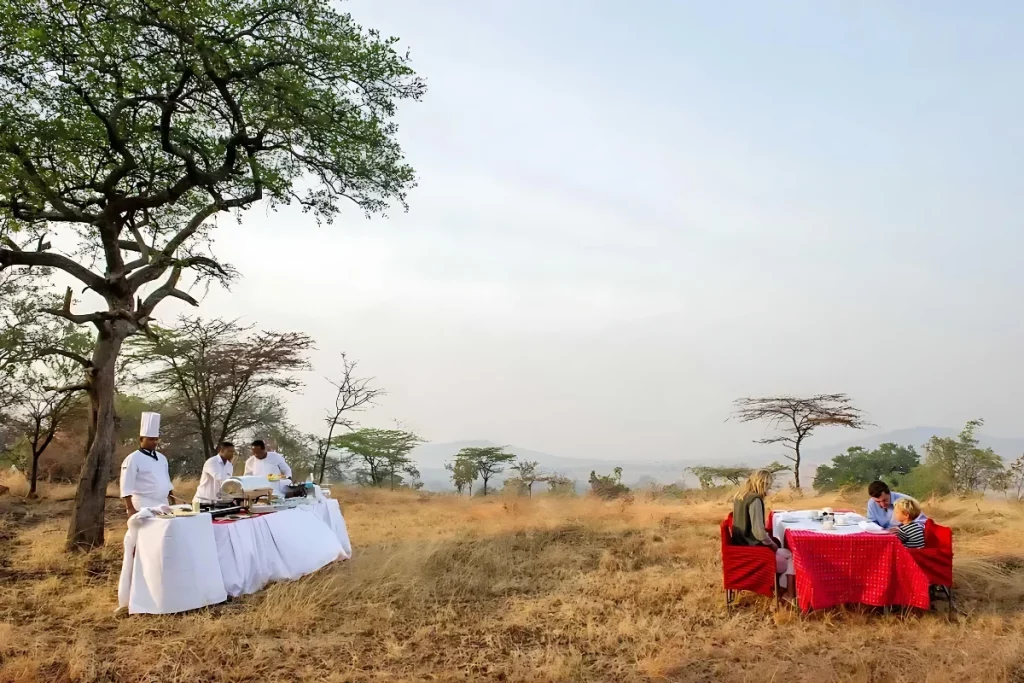
As you marvel at this incredible spectacle, imagine savoring a gourmet meal in the heart of the Serengeti, surrounded by roaming herds and breathtaking vistas of Namiri Plains, Ndutu area, or the western part where it is completely excluded.
The Ngorongoro Crater: Dining Inside an Ecological Impossibility
The crater floor sits 600 metres below the caldera rim, and the ecosystem within it operates in a state of extraordinary density: lions, elephants, black rhinos, flamingos at the soda lake’s edge, and a predator-prey balance maintained by the natural enclosure of ancient volcanic walls.
A bush dining experience at Ngoitoktok, beside the hippo pool at the crater’s heart, places you inside this improbability with a meal in front of you and the full spectacle of the crater’s theatre as the backdrop.
This is not a picnic in a scenic location. It is lunch at the centre of one of the most intact natural systems on the planet. The distinction is not rhetorical — it is the difference between witnessing something and being inside it.
Tarangire National Park | Tanzania Bush Dining Experience
Tarangire’s defining quality during the dry season is concentration. The Tarangire River acts as the last water source for hundreds of kilometers, and what gravitates toward it — elephant herds in the hundreds, zebra, oryx, giraffe moving between the ancient baobabs — creates a density of wildlife that gives the landscape the character of a cathedral in active use.
A table set in the long grass above the river bend, with that movement below you and the baobab silhouettes behind, requires a very specific kind of conversation: the kind that begins with silence.
Ruaha: The Candlelit Honesty of an Unedited Landscape
Ruaha does not soften itself for the visitor. Tanzania’s largest national park is remote by design and intention, and the landscape reflects this — rocky escarpments, the Great Ruaha River running low and dramatic through the dry season, a predator population that includes the highest density of lion in East Africa.
A dinner set on one of the granite kopjes as darkness comes in, lit only by fire and candlelight, surrounded by the specific audio landscape of a Ruaha night, is among the most honest dining experiences Africa offers: no artifice, no ambient design, nothing between you and the scale of what surrounds you
Selous Game Reserve | Nyerere National Park
The Rufiji River system that threads through the Nyerere National Park — formerly Selous Game Reserve, one of Africa’s largest protected areas — creates a dining context unavailable anywhere else in Tanzania.
The Craft Behind the Setting
The timing of a bush dining experience is not incidental. The dry season — June through October — concentrates wildlife around permanent water and delivers the sustained low-angle light that makes the late afternoon a different category of experience from any other time of day.
The green season, from March through May, transforms the landscape into something lush and dramatically lit by storm clouds, but the dispersal of game and the unpredictability of rain make the logistical calibration more demanding. The decision of when to go, and where within Tanzania, shapes the entire character of what the meal becomes.
Every dietary requirement — vegetarian, vegan, Kosher, allergen-specific — is accommodated without compromise. The cuisine is not a catered insert into an outdoor experience.
It is prepared with the same intelligence as the site selection: local ingredients, seasonal awareness, and the understanding that a meal eaten in a place this particular deserves a kitchen that takes its brief seriously.
The Perfect Time for Bush Dining
If you want to make the most of your bush dining experience in Tanzania, the dry season is the perfect time to visit. The dry season spans June and October, offering outstanding weather conditions and incredible wildlife sightings.
During the dry season, animals meet around water sources, creating a supreme opportunity to witness the Circle of Life. Imagine dining while observing herds of elephants quenching their thirst or lions lazily resting after a successful hunt. These breathtaking moments are more likely to occur during the dry season, adding a touch of charm to your bush dining experience.
Safety Considerations
While bush dining can create noteworthy memories, it is crucial to prioritize safety. Tanzania is known for its diverse wildlife, including the superb big cats. Choosing reputable and experienced safari operators that prioritize safety protocols is essential.
When indulging in bush dining, always follow the instructions of your guides and avoid approaching or feeding wild animals. Remember, these animals are wild and unpredictable, deserving our respect and love from a safe distance.
GET IN TOUCH WITH OUR EXPERT
Start Planning
Plan this trip
Tanzania safari itineraries
- Twelve Days. A Luxury Tanzania Honeymoon, Uninterrupted. →
- Two Chairs at the Crater Rim. A Tanzania Honeymoon. →