
No guide alive can tell you when a Mara River crossing will happen. They can tell you where the herd is, how long it has been massing at the bank, how the crocodiles have positioned themselves, and which way the wind is moving.
They can read the body language of 10,000 wildebeest and tell you whether the energy at the front rank feels like commitment or hesitation.
They can place you at the right point on the right bank with the right orientation before a single animal has entered the water. What they cannot do is produce the crossing on demand. And this, precisely, is what makes the Mara one of the last genuinely unscripted spectacles available to a traveller willing to be patient.
This is a field dispatch from six days at the Mara. Not a logistical itinerary. A narrative of intelligent anticipation.
The crossing does not reward people who arrive. It rewards people who wait — and who know what to do with the waiting.”
Day One: Arrival and Orientation
The flight from Arusha or Nairobi into the northern Serengeti takes approximately an hour and crosses a landscape that makes the concept of scale tangible in a way that maps and documents never do.
The camp sits in private concession land adjacent to the Mara River system, positioned specifically to allow access to the crossing points without the transit time that drains the energy of a safari day before it begins. The afternoon of arrival is not an itinerary item. It is a decompression chamber.
Your guide gives you a twenty-minute orientation of the immediate terrain — the crossing points currently being used, the herd’s location and movement pattern, the crocodile populations at each site — and then releases you to eat, to sit by the fire, to begin the recalibration that the Serengeti demands of an arriving nervous system.
Days Two and Three: Reading the Herd
The crossing, if you are watching for it rather than waiting for it, begins in the behaviour of animals on the eastern bank at dawn.
The herd’s arrival at the riverbank is not a random event — it is the product of grass depletion that has been tracking northward for months, and your guide has been monitoring the herd’s position and rate of movement since before your arrival.
Days two and three are the intelligence-gathering phase: the guide is reading the herd’s massing behaviour, identifying the approach corridors, and assessing which crossing point has accumulated the most pressure.
These two days will likely produce no crossing. What they produce instead is the specific quality of anticipation that makes the crossing, when it finally comes, feel like something your body has been preparing for.
You begin to read the signs independently. You understand why the guide stopped the vehicle at this particular point and not the one two hundred meters further along. The Serengeti begins to operate not as a backdrop but as a text.
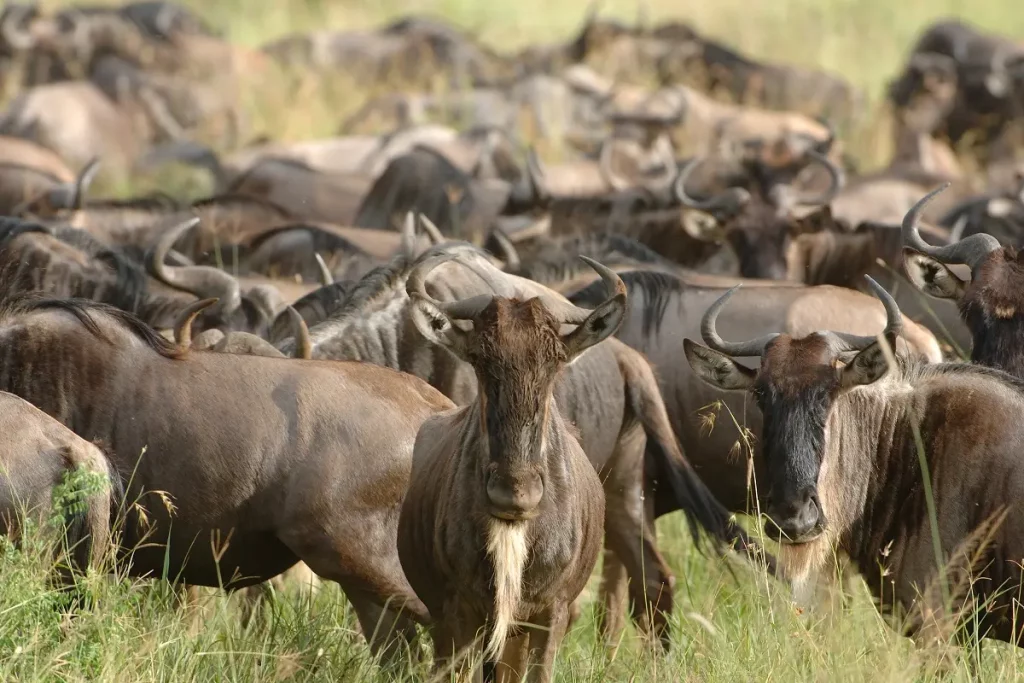
Three days of watching a herd that hasn’t moved yet is an education that no wildlife documentary has ever managed to deliver.”
Day Four: The First Commitment
It begins without announcement. The front rank of the herd, which has been pacing and retreating along the bank for hours, makes a micro-decision that cascades instantly through the animals immediately behind it.
Your guide has positioned the vehicle at the primary crossing point forty minutes before this moment, having read a convergence of signals: the wind, the herd density at the bank, the withdrawal of two large crocodiles from their sunning position to mid-river depth.
The crossing that follows is not a single fluid event. It is a series of surges, retreats, individual decisions made in real time by animals operating at the edge of their survival instinct.
Crocodiles of two and three meters move with an efficiency that is almost mechanical. The wildebeest that make it across the first surge shake the water from their flanks on the far bank and immediately begin grazing, as though the river had been nothing more than an inconvenience.
The ones that do not make it disappear into the current with a speed that the human mind takes several seconds to fully process.
The entire crossing, from first animal in to the last straggler finding the bank, takes between eleven minutes and two hours depending on the momentum of the herd. Your guide does not speak during it unless you ask a specific question.
Day Five: After the Crossing
The day after a major crossing has its own character. The herd has broken into smaller sub-groups on the Kenyan side, and the northern Serengeti’s concession land — accessible to your camp’s vehicles — is patrolled by the predators that have followed the migration north.
A lioness with three sub-adult cubs, her range now compressed to the western bank, is operating at the peak of her efficiency.
Your guide knows her tracks. He knows where she bedded the previous night and what direction she moved at dawn.
The morning drive is a tracking exercise that ends at an acacia grove where the family is watching a zebra herd with the focused patience of predators who are not hungry yet but will be.
This is the day that many travellers describe as the one that changed them. Not the crossing. The morning after, when the ecosystem settled back into its own rhythm and they were inside it with the time and the guidance to read it properly.
Day Six: Departure
The early flight out of the northern Serengeti crosses the ecosystem at altitude, and what you see from the window — the columns of animals threading south along the ancient migration corridor, the river a dark line through the tawny plains, the Lamai escarpment catching the first light — is a version of everything you have spent six days inside.
From up here it looks like a system. From down there it felt like a world. The distinction is the entire argument for going.
Best Add-ons for Serengeti Migration Safari.
Balloon Experience during River Crossing
To elevate your Serengeti safari to new heights, consider a balloon experience during the river crossing. Imagine floating gracefully above the vast plains, witnessing the wildebeest migration from a unique perspective. This breathtaking adventure will leave you in awe as you soar through the skies, capturing incredible photographs and making memories that will last a lifetime.
Bush Dining Experience during Serengeti Migration
Indulge your senses with a unique bush dining experience in the northern Serengeti during the wildebeest migration. Picture yourself enjoying a delicious meal under the African sky, surrounded by the sights and sounds of the wilderness. As the wildebeest make their treacherous journey across the Mara River, you can savor a sumptuous feast prepared by skilled chefs, creating an unforgettable dining experience.
Expert Guides for Optimal Viewing
To ensure you don’t miss a single moment of the Mara River crossing, it is crucial to have expert guides by your side. Our guides at East Africa Safari Guides possess extensive experience and intimate knowledge of the Serengeti and its wildlife patterns. They will take you to the right spot at the right time, maximizing your chances of witnessing this awe-inspiring event up close and personal.
We can say
The Serengeti Migration and the Mara River Crossing offer an extraordinary opportunity to witness the natural wonders of Africa. From the thrilling river crossings to the luxurious accommodations and unique experiences, this safari experience is like no other. Book your trip with East Africa Safari Guides and experience a journey that will leave you in awe of the beauty and power of nature. Just scroll down and view a 6-day fully itinerary, plan with our expert, book your flight ticket then sit back and enjoy the African adventure.
GET IN TOUCH WITH OUR EXPERT