
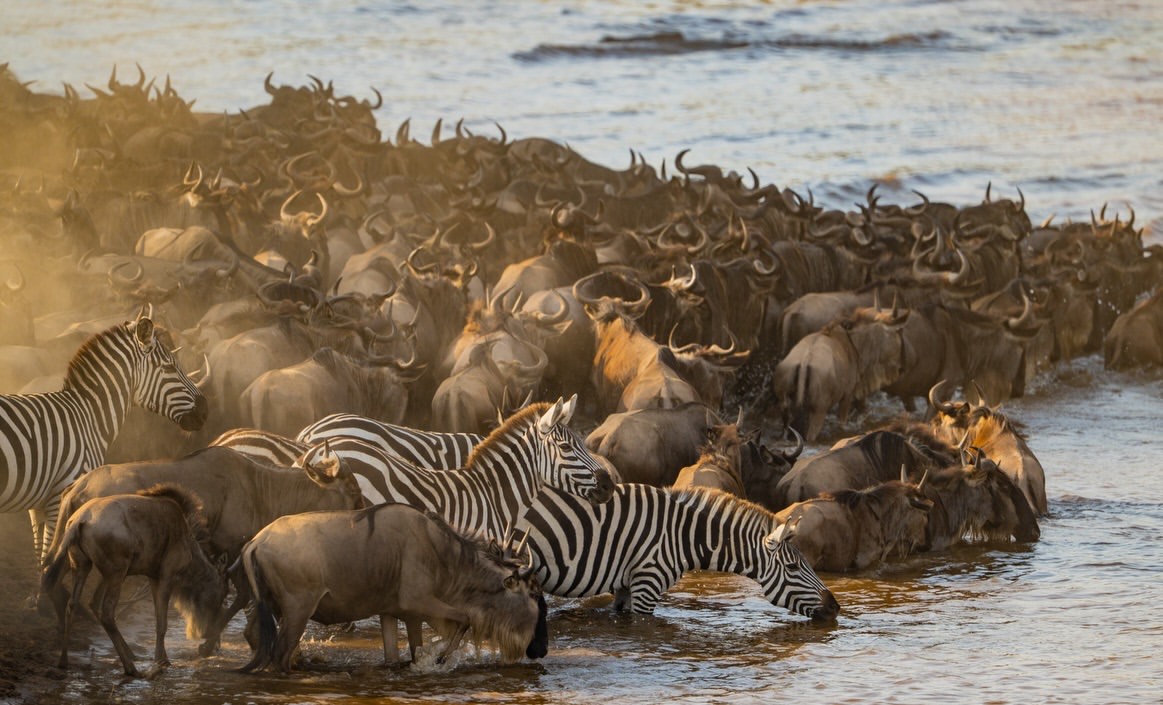
There is no date on the calendar. No confirmed departure, no published itinerary, no announcement of intention. The wildebeest migration — 1.5 million animals, 300,000 zebras, the attendant cast of predators that follows the feast — moves according to a logic that has been running uninterrupted for two million years, governed not by the Gregorian calendar but by rainfall patterns, grass chemistry, and a collective intelligence that science has never fully decoded. This is not a scheduled event. It is a permanent state of motion. And understanding the distinction between those two things is the first step toward witnessing it with the depth it deserves.
The migration does not begin. It does not end. It simply arrives wherever you are willing to wait for it.”
What the Migration Actually Is
Most travellers arrive expecting a single spectacle — the Mara River crossing, with wildebeest launching themselves into crocodile-patrolled water in their hundreds. That crossing exists. It is extraordinary.
It is also one scene in a 365-day production that spans an ecosystem larger than Switzerland, with a different act playing out in each of its zones at any given time of year.
To reduce the migration to the river crossing is to watch only the final chapter of a novel whose earlier chapters explain everything.
The circuit moves clockwise through the Serengeti-Mara ecosystem. The herds spend the green season in the south, calving on the nutrient-rich short-grass plains of Ndutu and the Ngorongoro Conservation Area boundary.
The Calving Season: The Act Most Travellers Miss
Between January and March, the short-grass plains of Ndutu in the southern Serengeti become the site of the most concentrated predator-prey theatre on the continent.
Approximately 500,000 wildebeest calves are born within a six-week window — a biological strategy called predator saturation, where the herd produces so many vulnerable young simultaneously that the predators cannot consume them fast enough.
The result is a plains landscape alive with newborns taking their first steps, and lions, cheetahs, wild dogs, and hyenas operating at the peak of their hunting cycles.
This is not a consolation prize for travellers who missed the river crossing. This is, by many measures, the more viscerally significant experience — the full ecosystem of birth, predation, and survival playing out in a compressed geography that allows your guide to position you within it with a precision that the vast northern Serengeti does not always permit.
The best guides in the Ndutu area do not find the action. They read the landscape well enough to be in position before the action begins.
The River Crossing: When the Herd Commits
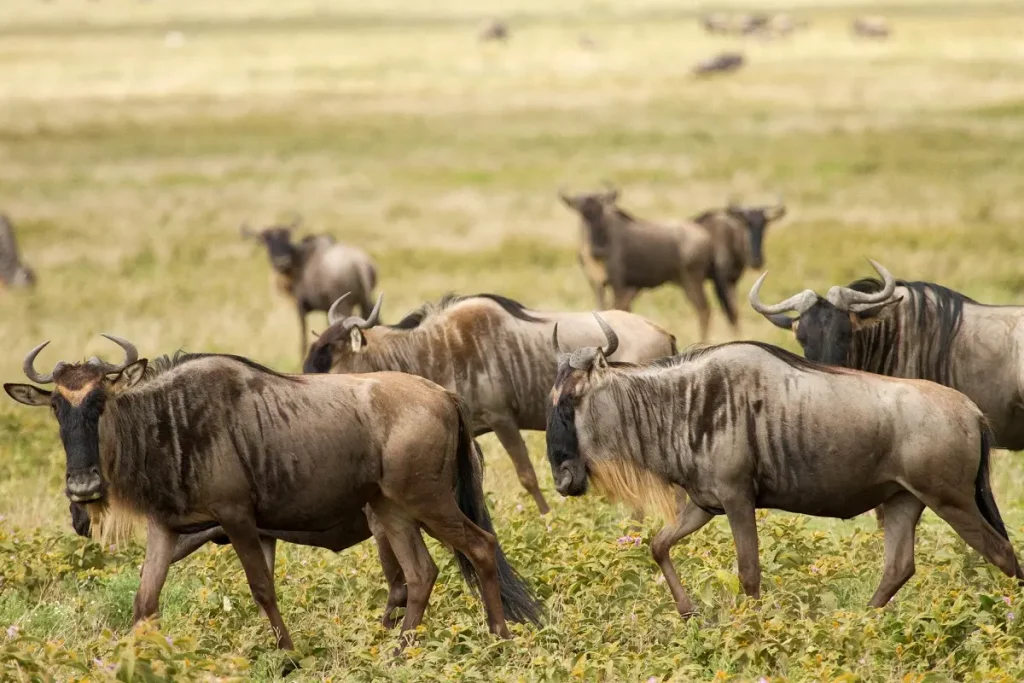
Between July and October, the northern Serengeti near Lamai and Kogatende becomes the stage for what many consider the most primally compelling sight in the natural world. The herd arrives at the Mara River and stops. Sometimes for hours. Sometimes for days.
The front rank looks at the water — at the crocodiles holding position just below the surface, motionless, patient beyond the human capacity for patience — and turns back.
The herd mills. The pressure from behind builds. And then, in a moment that has no clear trigger, no obvious leader, no detectable signal, the herd commits. What happens in the following minutes is the full force of evolutionary pressure compressed into a single stretch of river.
The quality of the experience depends entirely on where you are positioned, and where you are positioned depends entirely on the intelligence of your guide and the quality of your camp’s operational knowledge of the northern Serengeti.
The difference between watching the crossing from two hundred meters with fifty other vehicles and being in a private concession with one other vehicle at a rarely-used crossing point is not a detail. It is the entire experience.
Choosing Your Moment Within the Circuit
The most intentional travellers do not ask when is the best time to see the migration. They ask what kind of encounter they want — and design around the answer. Ndutu in February for the calving plains and the cheetah concentrations.
The central Serengeti in May and June as the herds consolidate before pushing north. Grumeti in June and July for the river crossing in a zone most travellers overlook entirely.
Lamai and Kogatende in August and September for the Mara crossings at their most dramatic. The southern plains again in November as the short rains draw the herds back and the circuit begins its next turn.
Each of these windows requires different camp placement, different guide expertise, and a different orientation of the game drive. We design for the specific window.
We do not offer a single migration package. We offer the migration as you specifically want to experience it.
The Mystery of the Wildebeest Migration Beyond the Horizon
How do the wildebeest determine their path? The prevalent hypothesis is that this grand adventure is piloted mainly by their climatic instincts, aligning their march with seasonal rains and fresh grass sprouting.
While no scientific backing supports this, the expert community entertains the idea that these gallant beasts respond to distant flashes of lightning and peals of thunder. This audacious proposition even suggests that wildebeest possess the uncanny ability to detect rain from over 50km away! The journey of these animals against the beautiful African backdrop remains as awe-inspiring as it is enigmatic.
Studies on the neuroscience of awe (Stellar et al., 2018) found that sustained exposure to vast, complex natural phenomena produces measurable reductions in inflammatory cytokines associated with chronic stress. Put plainly: standing at the edge of the Mara River as 10,000 wildebeest commit to the water does not merely feel significant. It changes the biochemistry of the body watching it.
GET IN TOUCH WITH OUR EXPERT